Emerging Security
Introduction to AI in Cybersecurity
AI is now on both sides of every cyber fight. Here is how it works, where it helps, where it fails, and how to start learning it.
10 min read
Level: Intermediate
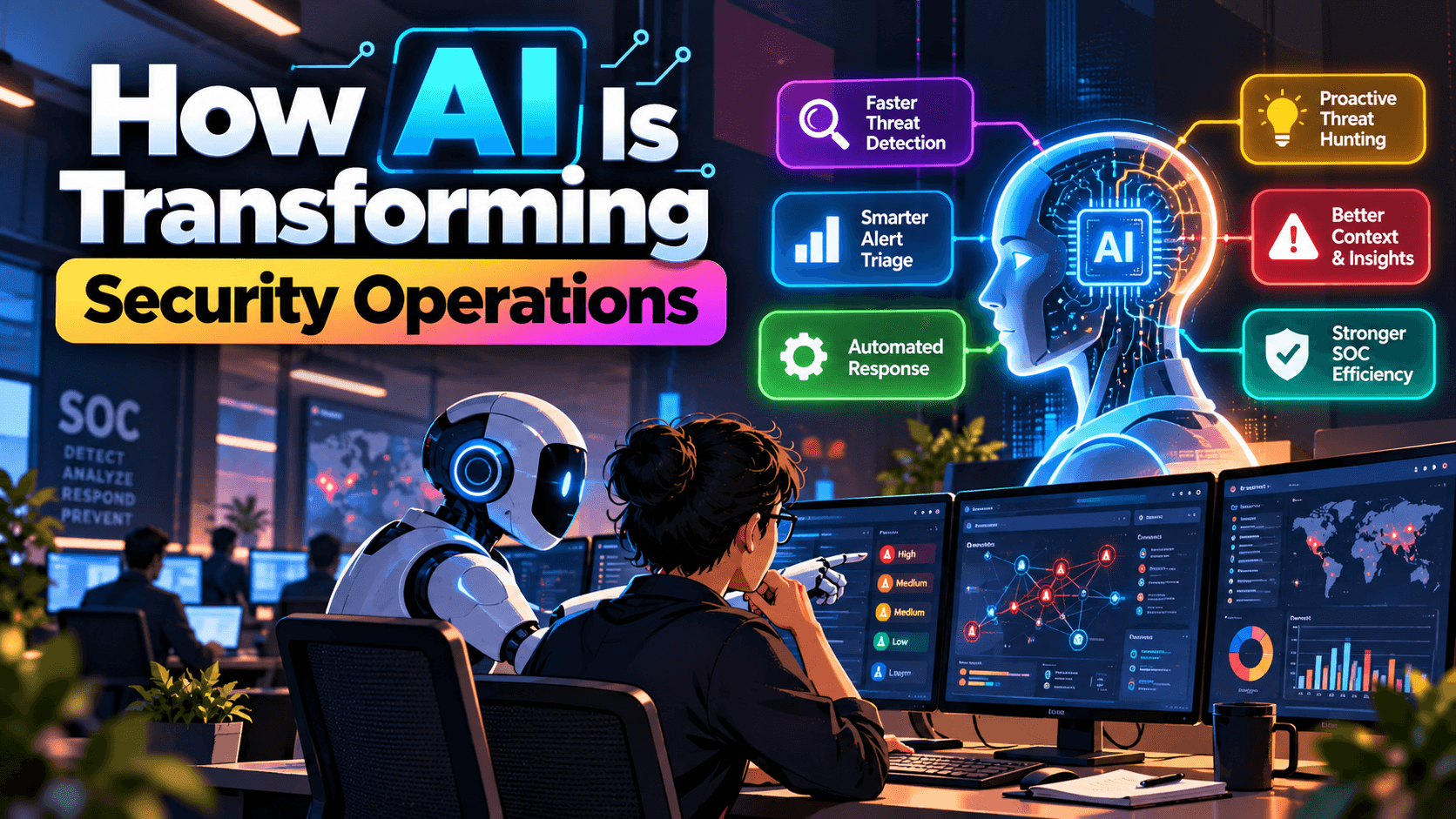
Security Operations Centers (SOCs) deal with an enormous amount of security data every day. Analysts may need to review thousands of alerts, correlate logs from different systems, investigate suspicious activity, enrich indicators, and respond to incidents—all while meeting strict response times.
Artificial Intelligence (AI) is changing how many of these activities are performed.
AI can help security teams analyze large volumes of data, identify patterns, prioritize alerts, automate repetitive tasks, and assist analysts during investigations.
However, AI is not a replacement for security analysts. Its value comes from helping analysts make faster and better-informed decisions.
AI in security operations refers to the use of technologies such as machine learning, natural language processing, large language models, and intelligent automation to support security monitoring, detection, investigation, and response.
A traditional SOC workflow might look like:
Alert → Analyst → Investigation → Enrichment → Decision → Response
An AI-assisted workflow can become:
Alert → AI Analysis → Enrichment → Prioritization → Analyst Validation → Response
The analyst remains responsible for validating important decisions.
Modern organizations generate huge amounts of security telemetry from:
SIEM platforms
EDR/XDR systems
Firewalls
Cloud platforms
Identity providers
Email security systems
Network monitoring tools
Threat intelligence platforms
Applications
The challenge is not simply collecting this information.
The challenge is determining:
Which events actually matter?
AI can help process large amounts of information and identify relationships that may be difficult to recognize manually.
One of the most practical uses of AI in a SOC is alert triage.
A SOC may receive hundreds or thousands of alerts in a day.
AI can assist by examining factors such as:
Alert severity
User identity
Host information
Previous activity
Threat intelligence
Related alerts
Process activity
Network connections
It can then help prioritize alerts for analyst attention.
Suppose a SIEM generates an alert for a suspicious login.
AI can help summarize:
User: user123 Source IP: Unknown Location: Unusual Previous activity: Normal MFA: Successful Related alerts: 2 Risk: Medium/HighInstead of starting from raw logs, the analyst receives a structured starting point for investigation.
Alert fatigue is a major SOC challenge.
When analysts repeatedly investigate low-value or repetitive alerts, important alerts can be overlooked.
AI can assist with:
Grouping similar alerts
Identifying duplicate events
Prioritizing higher-risk alerts
Adding contextual information
Identifying recurring benign patterns
For example:
100 similar alerts
may represent:
One underlying activity pattern
rather than 100 completely independent incidents.
This can help analysts focus their time on the alerts that require human attention.
Traditional detection often relies heavily on predefined rules.
For example:
IF failed_logins > threshold THEN generate_alertAI and machine-learning techniques can complement these rules by identifying unusual patterns in data.
For example:
Normal behavior:
User → London → Corporate laptop → Business hoursPotentially unusual behavior:
User → New country → New device → Unusual time → Sensitive resource accessThe unusual combination may deserve investigation even if no single event violates a predefined rule.
AI-based detection can therefore complement rule-based detection, behavioral analytics, and threat intelligence.
Threat hunting involves proactively searching for evidence of malicious activity that may not have triggered an alert.
AI can assist analysts by:
Generating hunting ideas
Identifying unusual patterns
Summarizing large datasets
Suggesting related indicators
Translating natural-language questions into searches
Helping correlate endpoint and network activity
For example, an analyst might ask:
"Show me unusual PowerShell activity from privileged accounts during the last seven days."
An AI-assisted security platform may help construct the appropriate query and summarize the results.
The analyst should still validate the query and findings.
During an investigation, analysts may need to review thousands of events.
AI can help organize this information into a timeline.
For example:
09:12 — Suspicious login 09:15 — MFA completed 09:18 — New device registered 09:21 — Privileged resource accessed 09:24 — PowerShell executed 09:30 — Large data transfer detectedInstead of manually reading every event, the analyst can use AI to identify important relationships and create an initial incident narrative.
This is particularly useful when data comes from multiple security technologies.
Security analysts frequently need to investigate indicators such as:
IP addresses
Domains
URLs
File hashes
Email addresses
User accounts
AI can help organize information gathered from threat intelligence sources and produce a concise summary.
For example:
IOC: suspicious-domain.example Reputation: Malicious First Seen: Recent Associated Malware: Unknown Related Infrastructure: 3 IPs Confidence: HighThe analyst can then determine whether the indicator is relevant to the organization's environment.
AI should not be treated as the authoritative source of threat intelligence. External intelligence sources and original evidence should remain the basis for important decisions.
AI can help analyze suspicious emails by examining:
Sender information
Email headers
URLs
Attachments
Message content
Impersonation indicators
Domain characteristics
It can help summarize why an email may be suspicious.
For example:
Potential indicators:
Newly registered domain
Lookalike sender domain
Urgent payment request
Suspicious URL
Attachment with unusual characteristics
AI can then help the analyst determine which indicators require further investigation.
Malware investigations can involve large amounts of technical information.
AI can assist with:
Static analysis summaries
Behavioral analysis summaries
Process relationships
Network indicators
File-system activity
Suspicious commands
Malware family research
For example, an analyst could provide sandbox results and ask AI to summarize the observed behavior.
The result might highlight:
Process Execution ↓ Persistence Attempt ↓ Network Connection ↓ Credential AccessAI can accelerate interpretation, but malware conclusions should still be validated using actual technical evidence.
AI can also support response activities.
Depending on the security platform and automation controls, AI-assisted workflows may help recommend actions such as:
Isolating an endpoint
Disabling an account
Blocking an IP address
Blocking a malicious domain
Resetting credentials
Creating an incident ticket
Collecting additional evidence
For high-impact actions, organizations should generally use human approval and appropriate safeguards rather than allowing an AI system to act without controls.
AI becomes particularly powerful when combined with Security Orchestration, Automation and Response (SOAR).
A simplified workflow could look like:
Security Alert ↓ AI Triage ↓ IOC Extraction ↓ Threat Intelligence Enrichment ↓ Risk Assessment ↓ Analyst Approval ↓ Automated Response ↓ Incident DocumentationThis can reduce the amount of repetitive manual work performed by SOC analysts.
SOC analysts spend significant time documenting incidents.
AI can assist in producing:
Investigation summaries
Incident timelines
Executive summaries
Analyst notes
Ticket updates
Incident reports
Lessons-learned documentation
For example, raw investigation notes can be transformed into a structured summary:
What happened → When it happened → Affected user/system → Evidence → Actions taken → Current status
The analyst should review the generated content before it becomes an official incident record.
AI can also support detection engineering.
It can help analysts:
Translate threat intelligence into detection ideas
Generate initial detection logic
Suggest relevant log sources
Map detections to MITRE ATT&CK
Identify missing telemetry
Review detection logic
Suggest ways to reduce false positives
For example:
Threat behavior → ATT&CK technique → Required telemetry → Detection logic → Testing → Deployment
AI can accelerate the process, but detection engineers must validate the rule against real environment data.
AI does not eliminate the traditional SOC. Instead, it can augment existing security processes.
AI also introduces new risks.
AI may incorrectly classify legitimate activity as malicious.
A malicious event may be incorrectly considered benign.
Generative AI can produce information that sounds convincing but is unsupported by evidence.
Security logs may contain sensitive information. Organizations must carefully control what data is sent to AI systems.
Attackers may attempt to manipulate the data or inputs used by AI systems.
Some AI-based decisions may be difficult to explain or reproduce.
Automatically taking destructive actions based on an incorrect AI decision can create additional damage.
Therefore, AI governance, validation, access controls, and human oversight are essential.
AI can process information quickly, but cybersecurity investigations require context and judgment.
An analyst understands:
Business context
User behavior
Asset criticality
Organizational policies
Incident severity
Operational impact
Evidence quality
A useful model is:
AI = Speed + Scale + Assistance
Human Analyst = Context + Judgment + Accountability
The strongest SOC combines both.
Security operations are increasingly moving toward AI-assisted workflows where repetitive analysis is automated and analysts focus on complex investigations.
Future SOC capabilities may include:
AI investigation assistants
Autonomous alert triage
Automated threat hunting
AI-generated detection rules
Continuous attack-path analysis
Automated incident summarization
AI-assisted purple teaming
Intelligent security orchestration
However, highly autonomous security operations will require strong safeguards, reliable telemetry, testing, and human oversight.
AI is transforming security operations by helping organizations process more security data, prioritize alerts, accelerate investigations, automate repetitive tasks, and improve analyst productivity.
The goal should not be:
"Replace the SOC analyst with AI."
Instead, it should be:
"Give SOC analysts AI-powered tools that help them investigate faster and make better decisions."
The modern SOC can be summarized as:
Telemetry → Detection → AI Assistance → Analyst Validation → Response → Continuous Improvement
3 entries, most recent posts.
Level: Intermediate
Category: Phishing / Artificial Intelligence

Severity: High CVSS: 8.7 Affected Products: Citrix NetScaler ADC & NetScaler Gateway Attack Type: Denial of Service / Possible Remote Code Execution