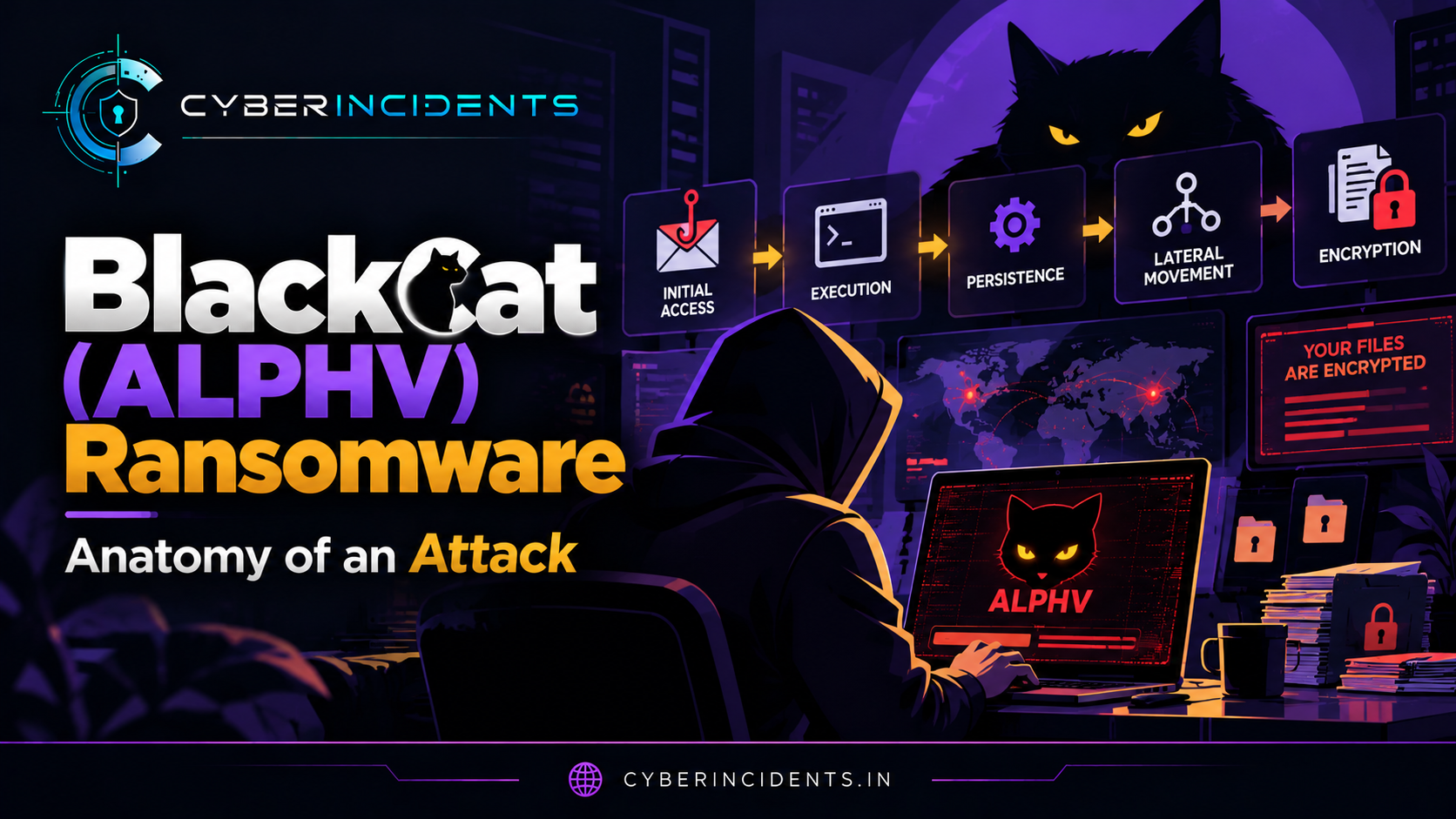
1. When Ransomware Becomes an Enterprise Crisis
Imagine a security team receiving several endpoint alerts early in the morning. Within minutes, employees report that shared files are inaccessible. Servers begin displaying ransom notes, business applications stop responding, and critical departments lose access to important data.
At first, the incident may appear to be a ransomware infection on a handful of computers. As investigators correlate the alerts, however, they discover suspicious activity involving multiple servers, administrative accounts, and shared network resources.
This is the kind of enterprise-level scenario that makes Ryuk an important ransomware case study.
Ryuk was associated with targeted campaigns in which attackers could spend time inside an organisation before deploying the ransomware. That preparation allowed them to identify valuable systems and increase the potential operational impact.
The result could be far more damaging than a single infected workstation: the organisation might lose access to business-critical infrastructure and face a lengthy recovery process.
2. What Is Ryuk Ransomware?
Ryuk is a ransomware family first observed in 2018. It became known for attacks against enterprise environments, including healthcare providers, public institutions, and large businesses.
Its primary purpose was to encrypt files and demand payment in exchange for the possibility of recovering access.
Ryuk was associated with targeted operations rather than relying solely on random, mass-distributed infections. In many reported campaigns, attackers first obtained access to a victim's network and conducted additional activities before deploying the ransomware.
These activities could include:
Compromising user or administrator accounts.
Exploring the internal network.
Moving between systems.
Identifying valuable servers and shared resources.
Attempting to weaken security and recovery capabilities.
Deploying ransomware across selected parts of the environment.
The exact sequence varied between incidents. Investigators should therefore avoid assuming that every Ryuk case follows an identical attack chain.
3. How Did Ryuk Attack Enterprise Networks?
Ryuk incidents were frequently associated with a broader intrusion rather than a standalone ransomware executable appearing without warning.
Stage 1: Initial access
Attackers gained access to victim environments through different methods. Historically reported Ryuk campaigns were associated with phishing, malicious attachments, and malware loaders, including Emotet and TrickBot in some operations.
These loaders could provide an entry point or help facilitate further compromise. Their presence should not automatically be treated as proof of a Ryuk infection, because the same malware families have been used in different campaigns.
SOC investigation: Review email security alerts, endpoint telemetry, suspicious downloads, authentication records, and the earliest known malicious activity.
Stage 2: Establishing a foothold
Following initial access, attackers might execute additional tools or malware to maintain access and prepare for further activity.
Investigators should look for unexpected process execution, suspicious persistence mechanisms, unusual remote access activity, and security alerts that precede the ransomware event.
SOC investigation: Build a timeline from endpoint detection and response (EDR), Windows event logs, identity logs, and network telemetry.
Stage 3: Credential access and privilege escalation
Enterprise ransomware operators have an incentive to obtain access to accounts with elevated privileges. Higher privileges can make it easier to access servers, deploy software, and affect multiple systems.
Potential warning signs include suspicious credential-access activity, unusual administrator logons, and unexpected changes to privileged accounts.
SOC investigation: Examine account logons, privilege assignments, remote authentication, and suspicious access to credential stores. Correlate the activity with the user's normal role and behaviour.
Stage 4: Discovery and lateral movement
Attackers may explore the environment to identify domain controllers, file servers, backups, and other valuable systems. They may then move between computers using compromised credentials or legitimate administrative mechanisms.
Lateral movement is especially important in enterprise investigations because it can explain how an intrusion expanded beyond the first compromised endpoint.
SOC investigation: Identify hosts communicating with one another unexpectedly, review remote logons and administrative tool usage, and establish which system was accessed first.
Stage 5: Preparing for impact
Before ransomware deployment, attackers may attempt to interfere with security tools, remove recovery options, or disrupt backup systems.
Such activity can increase the difficulty of containing the incident and restoring operations. However, these behaviours must be confirmed through evidence rather than assumed solely because Ryuk is suspected.
SOC investigation: Look for suspicious service changes, security-tool tampering, unusual backup administration, and unexpected deletion of recovery-related data.
Stage 6: Ransomware deployment
The attack reaches its most visible stage when files are encrypted and ransom notes appear. Depending on the incident, multiple endpoints, file shares, and servers may be affected.
By this stage, the organisation may already have experienced a substantial period of unauthorised activity.
SOC investigation: Determine the earliest confirmed encryption event, identify affected systems, preserve relevant evidence, and immediately coordinate containment.
4. Why Was Ryuk So Dangerous to Enterprises?
Ryuk's impact was not determined by encryption alone. The broader intrusion could increase the number of systems affected and make recovery more difficult.
Targeting valuable infrastructure: Enterprise environments contain shared storage, business applications, and centralised services that many employees depend on.
Compromised privileges: Access to powerful accounts can increase the attacker's ability to reach sensitive systems.
Lateral movement: An attacker who can move between systems may affect a much larger part of the organisation than one confined to a single workstation.
Operational disruption: Encrypted servers and shared resources can interrupt business processes, delay essential services, and create substantial recovery costs.
Limited recovery readiness: Organisations without isolated, tested backups may struggle to restore operations quickly.
Ryuk demonstrated why ransomware defence must address the entire intrusion lifecycle, not just the final act of file encryption.
5. How to Investigate a Ryuk Incident in a SOC
A structured investigation should answer five key questions:
Which systems and accounts were compromised?
How did the attacker initially gain access?
How did the attacker move through the environment?
What data, systems, and recovery mechanisms were affected?
Has the attacker been fully contained?
Step 1: Validate the detection
Review EDR, antivirus, SIEM, and threat-intelligence alerts. Determine whether the evidence confirms ransomware activity or indicates an earlier stage of an intrusion.
Collect the detection timestamp, hostname, username, process details, file paths, and associated network connections.
Step 2: Identify the first affected system
Do not assume the computer that first triggered an alert was the original entry point. It may simply have been the first system on which ransomware became visible.
Search historical logs for suspicious activity that occurred before encryption, including phishing-related events, malware execution, unusual logons, and unexpected remote access.
Step 3: Build an attack timeline
Correlate timestamps across:
EDR process and file telemetry.
Windows Security logs.
Identity-provider and authentication records.
Firewall and network detection logs.
Email security events.
Backup and administrative system logs.
Normalise timestamps and account for differences between systems. A reliable timeline helps investigators separate initial access, lateral movement, preparation, and impact.
Step 4: Investigate lateral movement
Identify unusual connections between endpoints and servers. Review remote logons, administrative shares, remote management activity, and account usage across multiple hosts.
Windows Security Event IDs can help establish the sequence of activity:
4624: Successful logon.
4625: Failed logon.
4672: Special privileges assigned to a new logon.
4688: Process creation, when process auditing is enabled.
7045: A service was installed, recorded in the System log.
These events are not proof of malicious activity by themselves. Investigators must correlate them with the host, account, process, timestamp, and expected administrative behaviour.
Step 5: Assess the scope and impact
Identify encrypted endpoints, affected file shares, critical servers, and systems that became unavailable.
Determine whether there is evidence of data staging or exfiltration before encryption. Ransomware incidents can involve data theft, but encryption alone does not establish that information was stolen.
Step 6: Contain the intrusion
Follow the organisation's incident response plan to isolate affected systems, restrict compromised accounts, and block confirmed malicious activity.
Coordinate closely with infrastructure and business teams, particularly when critical systems are involved. Preserve forensic evidence and document containment actions.
Step 7: Eradicate and recover
Remove the attacker's access, remediate the initial entry point, reset affected credentials as appropriate, and address security weaknesses identified during the investigation.
Restore systems from trusted backups only after the environment has been assessed and the threat has been contained. Validate the restored systems and monitor for signs of renewed compromise.
6. Indicators and Evidence to Look For
Ryuk investigations should focus on behaviour and correlated evidence rather than relying on a single filename, ransom note, or network connection.
Evidence sourceInvestigation focusEndpoint telemetryUnexpected process execution, ransomware detections, file-encryption activity, and security-tool tamperingIdentity logsUnusual administrator logons, compromised accounts, and suspicious privilege changesNetwork telemetryUnexpected connections between endpoints, servers, and administrative systemsEmail securitySuspicious attachments, phishing messages, and malware delivery eventsFile-system evidenceRansom notes, rapid file modifications, and affected shared resourcesBackup infrastructureUnusual administrative activity, failed backups, and suspicious deletion or modification of recovery dataData transfer logsUnusual outbound traffic or file staging that may indicate exfiltration
These are general investigation clues, not unique Ryuk indicators. Validate the ransomware family through trusted threat intelligence, forensic artefacts, and malware analysis.
7. MITRE ATT&CK Mapping
The following techniques may be relevant when supported by incident evidence. They are investigation mappings, not a claim that every Ryuk campaign used every technique.
TechniqueIDRelevancePhishing: Spearphishing AttachmentT1566.001Investigating malicious attachments where supported by the initial-access evidenceOS Credential DumpingT1003Investigating suspected credential theftRemote ServicesT1021Investigating movement between systems through remote access mechanismsFile and Directory DiscoveryT1083Investigating activity used to identify valuable files and resourcesImpair DefensesT1562Investigating attempts to disable or weaken security controlsData Encrypted for ImpactT1486Investigating ransomware file encryptionInhibit System RecoveryT1490Investigating activity that may prevent system restoration
8. Preventing Ryuk-Like Enterprise Attacks
Defending against enterprise ransomware requires controls that can interrupt multiple stages of an intrusion.
Strengthen email security. Filter malicious attachments and links, use sandboxing where available, and train employees to report suspicious messages.
Patch and harden systems. Maintain an accurate asset inventory, prioritise critical vulnerabilities, and remove unnecessary services and software.
Protect privileged accounts. Use multifactor authentication where supported, restrict administrative access, and separate everyday accounts from privileged accounts.
Segment the network. Limit unnecessary communication between user endpoints, servers, domain infrastructure, and backup systems.
Deploy EDR and centralised monitoring. Detect suspicious process execution, credential-access activity, lateral movement, and widespread file encryption.
Protect backups. Maintain offline or immutable copies where feasible, restrict backup administration, and regularly test restoration.
Monitor for early-stage intrusion activity. Investigate suspicious loaders, credential theft, abnormal logons, and unexpected administrative behaviour before ransomware is deployed.
Practise incident response. Run exercises that test endpoint isolation, account containment, evidence preservation, crisis communication, and recovery.
9. Lessons from Ryuk for Modern SOC Teams
Ryuk illustrates a critical principle of ransomware defence: the visible encryption event may be the end of a much longer intrusion.
If a SOC team focuses only on the ransom note, it may miss the compromised account, malicious loader, or lateral movement activity that enabled the attack.
A more effective investigation connects events across identity, endpoint, network, email, and backup systems. It establishes the earliest confirmed malicious activity, determines how far the attacker progressed, and verifies that access has been removed before recovery begins.
This approach also improves future detection engineering. Findings from an investigation can be converted into SIEM correlation rules, EDR detections, privileged-account monitoring, and alerts for suspicious movement between systems.
Conclusion
Ryuk became a significant enterprise ransomware threat because its operations were associated with targeted intrusions and widespread disruption. Its impact highlights the risks of compromised credentials, insufficient segmentation, weak recovery controls, and delayed detection of activity preceding encryption.
For SOC analysts, the objective is not simply to identify ransomware. It is to reconstruct the intrusion, establish its scope, contain the attacker, and support a safe recovery.
The key lesson: Detecting ransomware is important, but detecting and interrupting the intrusion before widespread encryption can make the difference between a contained incident and an enterprise-wide crisis.
Further Reading
MITRE ATT&CK — techniques for analysing ransomware and enterprise intrusions.
CISA — ransomware prevention and incident response guidance.
NIST — computer security incident handling and recovery guidance.