Cyber News
Com-Affiliated Hackers Exploit Vishing and MFA to Hijack Cloud Accounts and Steal Corporate Data
Vishing
17 min read
Security breach
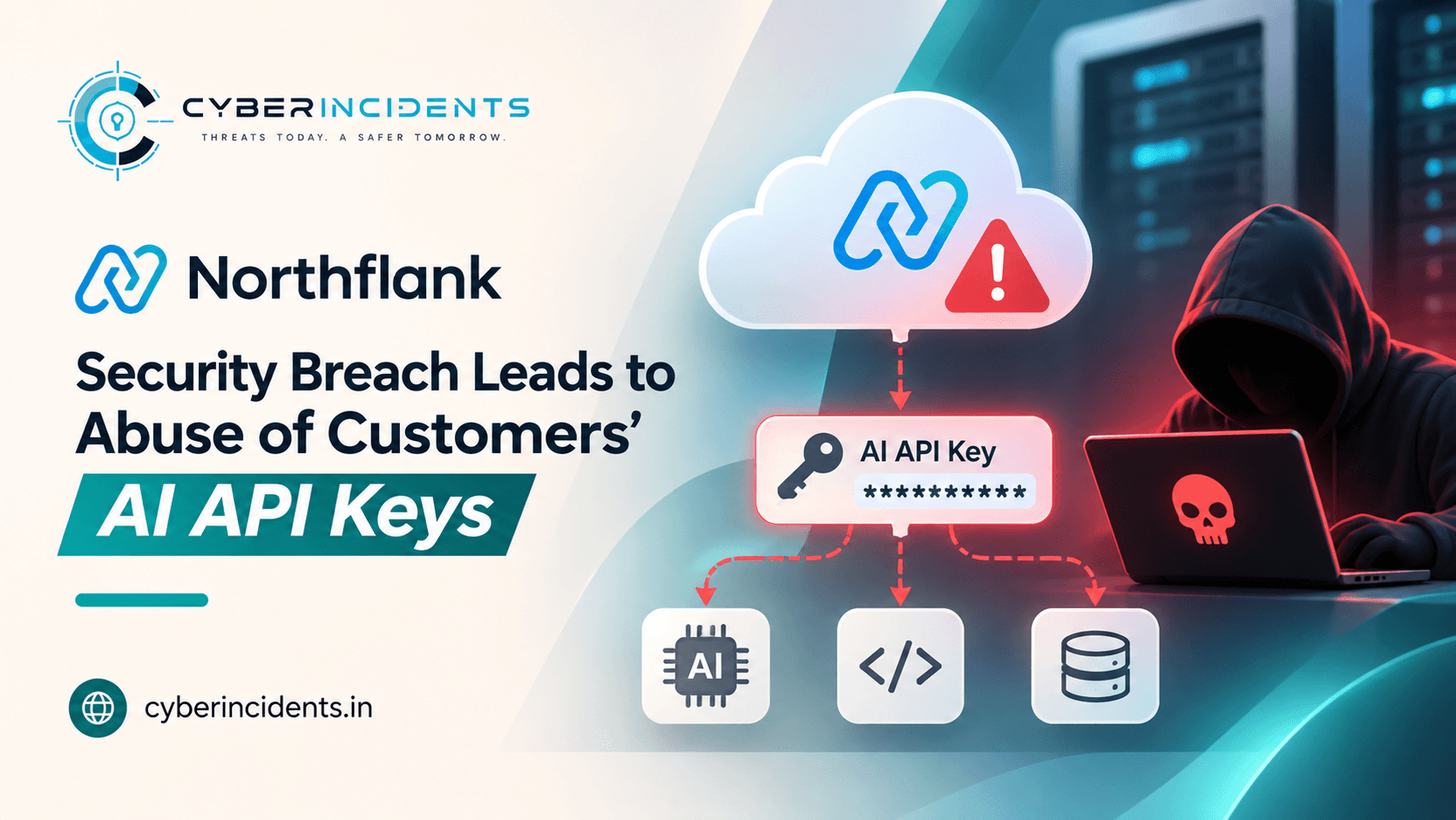
Cloud application hosting platform Northflank disclosed a security incident on October 30, 2026, after receiving a threat alert from cloud security company Wiz. The breach potentially exposed customer environment variables, including database credentials, cloud service secrets, authentication tokens, and AI API keys.
Northflank warned customers to assume that all environment variables had been decrypted and their secrets stolen. Multiple customers subsequently reported unauthorized use of AI API keys stored on the platform.
The incident highlights the growing risk of targeting cloud development platforms that centralize sensitive credentials. Stolen AI API keys can enable unauthorized model access, generate substantial financial costs, and potentially support LLMJacking operations.
Key points:
Customers were advised to rotate all secrets and API keys stored on Northflank.
Multiple customers reported unauthorized AI API key usage.
Northflank applied network policy patches and enabled customer audit logs.
The number of affected customers and the initial attack vector remain undisclosed.
The incident occurred amid a wider wave of attacks targeting AI development platforms.
On October 30, 2026, Northflank received a security alert from Wiz regarding a potential breach of its platform. Northflank's engineers reviewed the alert shortly afterward and began implementing security measures.
Northflank initially issued an urgent warning advising customers to rotate their environment variables and API keys. The company later escalated its guidance, telling customers to assume that all environment variables had been decrypted and that the secrets stored within them had been stolen.
Environment variables are commonly used by applications to store sensitive information, including:
Database usernames and passwords.
Cloud provider credentials.
Authentication tokens.
Third-party service API keys.
AI provider API keys.
Exposure of these secrets can allow attackers to access connected services without directly compromising each customer's infrastructure.
Northflank subsequently confirmed that multiple customers had reported unauthorized use of AI API keys supplied to its platform.
Stolen AI credentials can be abused to access commercial AI models and services using another organization's account. This can result in:
Unexpected AI API consumption.
Significant financial charges.
Unauthorized access to AI models.
Abuse of an organization's service quota.
Potential exposure of data submitted through unauthorized API requests.
Northflank advised customers to review their AI provider usage and billing logs, identify unexpected activity, and report suspicious usage to both Northflank and their respective AI providers.
According to the company's published incident timeline, the response began after Wiz issued its warning at 11:43 UTC on October 30.
Northflank implemented several security measures:
Applied an initial network policy patch.
Released additional patches at 12:50 UTC and 13:05 UTC.
Requested assistance from Wiz's incident response team.
Enabled credential rotation for PostgreSQL, MongoDB, MySQL, and Redis.
Enabled audit logs for all customers, including free-tier accounts.
The company also advised customers to rotate secrets stored in:
Workloads.
Secret groups.
Global secrets.
Customers were additionally advised to disable public access to add-ons wherever enabled.
The Northflank incident is part of a broader trend involving attacks against AI development platforms.
In its report, Black October for AI Developer Platforms, Wiz identified at least nine security incidents affecting AI development platforms during October 2026. These included incidents involving Northflank, Railway, OpenCode, Warp, and Lightning AI.
Wiz highlighted attempts to obtain environment variables containing AI service credentials.
One potential consequence is LLMJacking — the unauthorized use of stolen AI credentials to access large language models through another organization's API account.
Attackers can use compromised credentials to:
Generate AI content at the victim organization's expense.
Consume expensive model resources.
Resell access to AI models.
Generate substantial unauthorized API charges.
Wiz reported that, in two investigated cases, compromised enterprise credentials were used to make approximately 2.5 million Amazon Bedrock API calls, generating around $100,000 in AI usage.
However, Wiz did not confirm that all nine incidents involved the same attackers. The available reporting also does not establish that every incident was directly connected to the Northflank breach.
Northflank has not publicly disclosed:
The initial attack vector.
How attackers gained access to its systems.
The total number of affected customers.
Whether credentials beyond the reported AI API keys were accessed or abused.
The full extent of customer data exposure.
These details are important for determining the breach's complete impact.
The published report does not provide conventional indicators of compromise such as malicious IP addresses, domains, file hashes, or attacker infrastructure.
| Indicator | Details |
|---|---|
| Affected platform | Northflank |
| Incident date | October 30, 2026 |
| Potentially exposed data | Environment variables and stored secrets |
| Reported abuse | Unauthorized AI API key usage |
| Related activity | Potential LLMJacking |
These are incident investigation pivots, not confirmed malicious IOCs.
Security teams using Northflank or similar cloud development platforms should investigate potential credential exposure and unauthorized use.
Examine AI provider usage and billing logs for unexpected spikes.
Identify API calls outside normal business hours or established usage patterns.
Investigate unusual model selection, request volume, and token consumption.
Check for API activity originating from unfamiliar IP addresses or locations, where provider logs expose this information.
Identify API keys and secrets previously stored in Northflank.
Review credential last-used timestamps and associated source IPs.
Look for unexpected authentication failures followed by successful access.
Identify newly created API keys or changes to credential permissions.
Examine authentication and audit logs for PostgreSQL, MongoDB, MySQL, and Redis.
Investigate unexpected connections or authentication attempts.
Review cloud provider activity for unusual API operations.
Check whether exposed credentials were used to access additional services.
Investigate changes to workloads, secret groups, and global secrets.
Identify unexpected configuration changes.
Review add-on exposure settings and public access configurations.
Correlate suspicious activity with the incident timeline.
Organizations using Northflank or other cloud application hosting platforms should prioritize credential security.
Rotate all stored secrets: Replace credentials stored in workloads, secret groups, and global secrets.
Revoke exposed API keys: Disable old AI API keys and generate new ones.
Review billing activity: Check AI provider usage dashboards for unexpected consumption and charges.
Restrict API permissions: Apply least-privilege permissions and usage limits wherever supported.
Secure database access: Rotate database credentials and restrict network exposure.
Disable unnecessary public access: Review add-ons and remove public exposure where it is not required.
Enable audit logging: Retain and monitor platform, cloud, database, and AI provider audit logs.
Monitor for credential abuse: Alert on unusual API consumption, unexpected authentication locations, and abnormal access patterns.
Avoid long-lived credentials: Use short-lived credentials or workload identity mechanisms where supported.
SOC Recommendation: Treat secrets stored on a potentially compromised hosting platform as exposed until they have been rotated and validated. Rotating an API key alone is insufficient if the old key remains active or if the same secret is reused across other services.
Continue reading
Cyber News
Vishing
Cyber News
Identity Theft and Data Extortion
Cyber News
Credentials Compromise
3 entries, most recent posts.
Vishing
Identity Theft and Data Extortion
AI-Assisted Autonomous Intrusions