1. Introduction: When One Attack Is Not Enough
An online service can remain operational during a substantial traffic surge if its infrastructure has sufficient capacity and its defensive controls are configured correctly. However, the situation becomes more complicated when the incoming traffic targets several different weaknesses at the same time.
Imagine an organisation hosting an online banking platform. Its network monitoring system detects an unusual increase in incoming traffic. At the same time, the web application begins responding slowly, API requests accumulate, and database connection pools approach their limits.
The network team investigates bandwidth consumption, while the application team examines slow requests and database performance. Each team sees a different symptom of the same incident.
This is one of the challenges presented by a multi-vector DDoS attack.
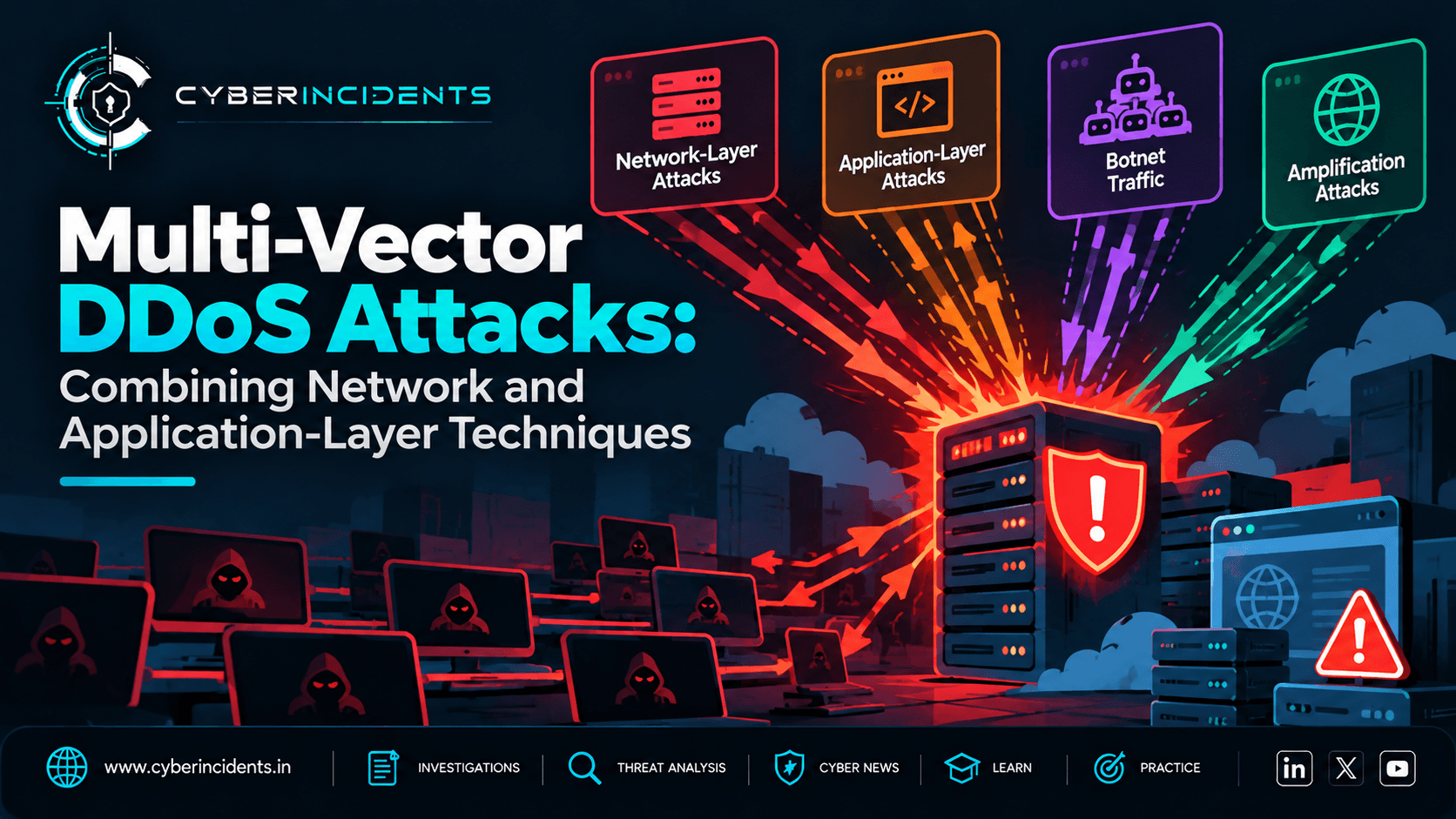
Rather than relying on a single traffic pattern, an attacker combines techniques designed to affect different components of the service. Network-layer traffic may consume bandwidth or overwhelm packet-processing capacity, while application-layer requests exhaust server resources through expensive operations.
The result can be more difficult to diagnose and mitigate than a single-vector attack.
For SOC analysts, network engineers, and incident responders, the priority is to determine which resources are under pressure, how the attack vectors interact, and which defensive controls can restore availability without unnecessarily blocking legitimate users.
2. What Is a Multi-Vector DDoS Attack?
A Distributed Denial-of-Service attack attempts to make a system or service unavailable by overwhelming its resources or interfering with its ability to handle legitimate requests.
A multi-vector DDoS attack combines two or more attack methods, potentially targeting different layers of the network and application stack.
Common combinations include:
Volumetric traffic floods that consume available network bandwidth.
Protocol-level attacks that place pressure on connection handling or network-device resources.
Application-layer floods that generate large numbers of HTTP or HTTPS requests.
Attacks against expensive API endpoints that consume disproportionate processing or database resources.
These vectors can occur simultaneously or change throughout the incident.
For example, an attacker might generate a large volume of network traffic while sending application requests designed to keep web servers busy. Alternatively, the attacker may switch vectors as defenders introduce filtering or rate limits.
The defining characteristic is not simply high traffic volume. It is the use of multiple attack mechanisms against different resource constraints.
3. Understanding the Layers Under Attack
To investigate a multi-vector DDoS incident effectively, defenders need to understand which components are being targeted.
<box border radius="lg" padding={3} gap={3}>
<box background="surface-secondary" radius="md" padding={3} gap={1}>
<title size="md">Layer 3–4: Network and Transport</title>
<text size="sm">Targets bandwidth, packet processing, connection establishment, or network-device state.</text>
<text color="secondary" size="sm">Examples: volumetric floods, TCP SYN floods, UDP floods.</text>
</box>
<box align="center">
<icon name="arrow-down" size="lg" color="secondary" />
</box>
<box background="surface" border radius="md" padding={3} gap={1}>
<title size="md">Layer 7: Application</title>
<text size="sm">Targets HTTP services, APIs, authentication workflows, or computationally expensive requests.</text>
<text color="secondary" size="sm">Examples: HTTP request floods and resource-exhaustion attacks.</text>
</box>
<box align="center">
<icon name="arrow-down" size="lg" color="secondary" />
</box>
<box background="surface-secondary" radius="md" padding={3} gap={1}>
<title size="md">Service Impact</title>
<text size="sm">Legitimate users experience latency, errors, timeouts, or complete unavailability.</text>
</box>
</box>
Network and transport-layer attacks
Network-layer and transport-layer attacks target the infrastructure responsible for delivering traffic and managing connections.
Depending on the technique, they may consume bandwidth, increase packet-processing overhead, or exhaust connection-state resources on servers and network devices.
A TCP SYN flood is one example: large volumes of connection attempts can place pressure on resources used during TCP connection establishment.
Application-layer attacks
Application-layer attacks target the behaviour of the service itself.
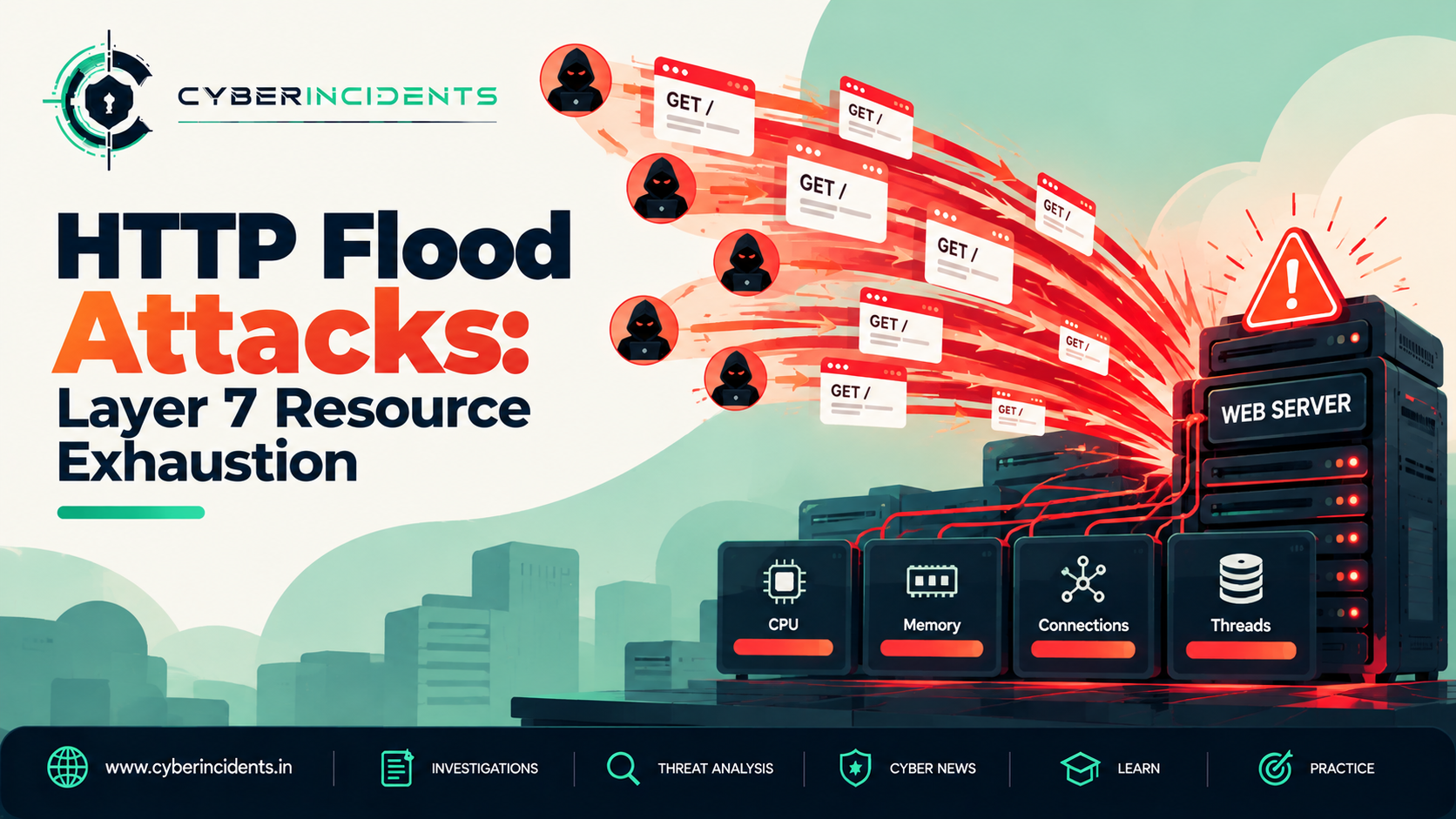
An HTTP flood may generate a high rate of requests, while a more selective attack may repeatedly access endpoints that require expensive database queries, authentication operations, or other processing.
Application-layer attacks can be particularly challenging because requests may use valid HTTP methods, follow normal protocol rules, and resemble legitimate user activity.
Why combining these layers matters
The network may have enough bandwidth to remain operational while the application becomes overloaded. Conversely, a web application may be performing normally until network congestion prevents requests from reaching it.
When several vectors are active, defenders must distinguish the different bottlenecks rather than assume that one traffic metric explains the entire incident.
4. How Multi-Vector DDoS Attacks Unfold
A multi-vector attack does not always follow a fixed sequence, but a common incident pattern can be described in several stages.
Stage 1: Traffic generation
The attacker generates traffic from distributed systems or other sources. The traffic may target a public IP address, a network service, a web application, or several exposed components.
Stage 2: Multiple resource constraints emerge
Network traffic may begin consuming bandwidth or increasing packet-processing demand while application requests place pressure on web servers, APIs, or databases.
The vectors can operate independently, but their combined effect may reduce the service's ability to recover.
Stage 3: Infrastructure symptoms appear
Monitoring systems may report increased traffic, connection failures, elevated CPU utilisation, growing request queues, or reduced application throughput.
Different components may exhibit different symptoms, making it important to correlate telemetry across the infrastructure.
Stage 4: Defences respond
Network devices, DDoS protection services, web application firewalls, and application-level controls may begin filtering or limiting traffic.
An attacker may continue using other vectors that are not adequately covered by the current mitigation.
Stage 5: Service availability degrades
If the attack exceeds available capacity or bypasses relevant controls, legitimate users may experience prolonged delays or complete service disruption.
The incident may continue until the traffic is mitigated, the attack stops, or the organisation changes its architecture or defensive posture.
5. Why Multi-Vector Attacks Are Difficult to Detect
Different attack vectors create different symptoms
A bandwidth flood may be obvious in network telemetry, while an application-layer attack may produce relatively ordinary traffic volumes but unusually high backend resource consumption.
Investigating only one telemetry source can therefore leave part of the attack unexplained.
Malicious requests can resemble legitimate activity
Application-layer traffic may use valid HTTP requests and encrypted HTTPS connections. A request's protocol validity does not establish that its purpose is legitimate.
Defenders need to consider request rates, endpoint distribution, session behaviour, response codes, backend resource consumption, and the historical baseline.
Encryption limits payload visibility
HTTPS protects data in transit, so network devices without appropriate application-layer visibility may not be able to inspect the full request.
However, useful metadata may still be available, including connection rates, TLS session information, destination addresses, traffic volume, and timing. Application gateways and servers can provide additional request-level telemetry.
Attack patterns can change
Traffic distribution, request rates, and targeted endpoints may change throughout an incident. A mitigation that initially reduces the impact may become less effective if the attack shifts to a different resource.
Shared infrastructure complicates attribution
Requests may originate from cloud infrastructure, residential networks, proxies, or compromised devices. Source IP addresses alone rarely establish who is responsible.
The immediate defensive objective is to restore service and identify malicious traffic patterns, not to make unsupported claims about attacker identity.
6. SOC Investigation: A Step-by-Step Workflow
A structured investigation helps teams determine whether a service disruption is caused by a multi-vector DDoS attack or another infrastructure failure.
Step 1: Confirm the availability incident
Establish when the disruption began, which services are affected, and whether users are experiencing timeouts, elevated latency, or failed connections.
Compare external availability checks with internal service-health metrics.
Step 2: Investigate network-layer traffic
Review bandwidth utilisation, packets per second, protocol distribution, connection attempts, and firewall or load-balancer counters.
Determine whether the network or transport layer is experiencing unusual pressure.
Compare current traffic with historical baselines and normal business activity.
Step 3: Investigate application-layer behaviour
Examine HTTP access logs, API gateway telemetry, response codes, request rates, and endpoint-level latency.
Look for unusual concentrations of requests, repeated expensive operations, or a sudden increase in requests that consume significant backend resources.
A high request rate alone is not conclusive. Legitimate traffic surges, product launches, and software retries can produce similar patterns.
Step 4: Correlate infrastructure health
Review CPU utilisation, memory pressure, worker pools, database connection counts, request queues, and upstream dependency health.
Identify whether the bottleneck is network capacity, connection handling, application processing, or a backend service.
Step 5: Correlate the attack vectors
Construct a common timeline from network, security-device, application, and infrastructure telemetry.
Determine whether network anomalies and application anomalies occurred simultaneously, followed one another, or represent unrelated events.
This step is important because multiple symptoms do not automatically mean that multiple attack vectors are present.
Step 6: Apply targeted mitigation
Coordinate with the network, application, cloud, and incident-response teams.
Mitigation should address the identified bottlenecks and be adjusted as new evidence emerges.
Step 7: Verify recovery
Confirm that legitimate users can access the service, backend metrics have stabilised, and mitigations are not producing excessive false positives.
Continue monitoring for changes in traffic patterns and recurring resource pressure.
Step 8: Document the incident
Record the timeline, affected services, observed vectors, measured impact, mitigation actions, and remaining uncertainties.
Separate confirmed attack behaviour from suspected activity and alternative explanations.
7. Evidence and Indicators to Monitor
The following indicators can help analysts investigate potential multi-vector DDoS activity.
Telemetry sourceIndicatorsInvestigative valueNetwork monitoringBandwidth, packets per second, protocol distributionIdentifies volumetric and protocol-level pressureFirewall and load balancerConnection rates, drops, queue occupancy, session countsHelps locate connection-handling bottlenecksWeb server logsRequest rates, status codes, request paths, latencyReveals application-layer patternsAPI gatewayEndpoint-level requests, throttling, authentication failuresIdentifies heavily targeted API operationsApplication monitoringCPU, memory, worker saturation, request queuesEstablishes service-resource exhaustionDatabase monitoringConnection pools, query latency, active queriesIdentifies backend pressure caused by application requestsCDN and DDoS providerMitigated traffic, attack classifications, origin trafficShows how much traffic is absorbed upstreamAvailability monitoringTimeouts, error rates, user-facing latencyMeasures the actual impact on users
Analysts should avoid using a single threshold as definitive proof of an attack. Traffic volume, source diversity, and error rates need to be interpreted in the context of the affected service and its normal operating patterns.
8. Mitigation: Defending Multiple Layers
A resilient defence uses several controls that complement one another.
Network-layer DDoS protection
Use upstream DDoS protection, traffic scrubbing, and suitable network filtering to address traffic that exceeds local capacity.
When the internet connection itself is saturated, local firewall rules may not be sufficient because the unwanted traffic has already consumed the available link.
SYN cookies and connection controls
Where TCP connection-state exhaustion is the problem, SYN cookies, suitable backlog configuration, and carefully tuned connection handling can help.
These measures do not solve every network flood and should be matched to the actual bottleneck.
Content delivery networks and reverse proxies
CDNs and reverse proxies can absorb traffic, distribute requests, and protect origin servers from direct exposure.
Their effectiveness depends on architecture, caching, configuration, capacity, and whether attackers can bypass the protected entry point.
Web application firewalls
A WAF can apply rules to HTTP traffic, limit certain request patterns, and block requests that match suspicious behaviour.
It is not a complete substitute for network-layer DDoS protection. Large traffic floods may exhaust infrastructure before application-level inspection can help.
Rate limiting and API protection
Rate limits can protect expensive endpoints and reduce abuse of authentication or other sensitive workflows.
Limits should account for legitimate traffic patterns, shared IP addresses, authenticated user behaviour, and the potential for attackers to distribute requests across many sources.
Application optimisation
Reduce unnecessary backend work, cache suitable responses, optimise database queries, and establish sensible resource limits.
An application that handles ordinary requests efficiently is generally better positioned to withstand traffic surges.
Capacity planning and incident readiness
Establish escalation paths with hosting providers and DDoS mitigation services before an incident occurs.
Test failover procedures, validate logging coverage, and ensure that teams can coordinate changes without introducing additional outages.
9. Common Analyst Mistakes
Focusing exclusively on bandwidth. Application-layer attacks can exhaust backend resources without saturating the network link.
Treating all high-volume traffic as malicious. Legitimate demand spikes and software defects can create similar symptoms.
Relying only on source IP blocking. Distributed attacks can involve many sources, while shared addresses may serve legitimate users.
Applying a WAF rule to a network-layer bottleneck. Application filtering cannot recover bandwidth already consumed upstream.
Ignoring backend dependencies. A database or external API may be the actual bottleneck rather than the web server.
Failing to correlate timelines. Network and application anomalies may be related, but that relationship should be established using evidence.
Stopping monitoring after traffic drops. Attack patterns can change, and service recovery should be verified across all affected layers.
10. MITRE ATT&CK Mapping
MITRE ATT&CK provides relevant techniques for describing denial-of-service behaviour. The final mapping should reflect the vectors actually observed during the incident.
TechniqueIDRelevanceNetwork Denial of ServiceT1498Network traffic overwhelms capacity or availabilityDirect Network FloodT1498.001Direct flooding of a target with network trafficEndpoint Denial of ServiceT1499Denial of service through exhaustion of endpoint resourcesApplication Exhaustion FloodT1499.003Application requests exhaust service resources
A multi-vector incident may involve more than one technique. For example, a network flood combined with an application exhaustion flood may affect different components simultaneously.
Do not assign every listed technique automatically. Confirm which behaviours occurred and whether the relevant resources were actually targeted.
Conclusion
Multi-vector DDoS attacks demonstrate why service availability cannot be protected through a single defensive control. Network-layer floods may consume bandwidth or connection-handling resources, while application-layer attacks place pressure on web servers, APIs, and backend systems.
For SOC analysts and incident responders, the most effective approach is to correlate packet and connection telemetry with application logs, infrastructure metrics, and user-facing availability. This helps identify the actual bottlenecks and select mitigations that address the attack without unnecessarily disrupting legitimate traffic.
Organisations should combine upstream DDoS protection, network controls, application-layer filtering, rate limiting, resilient architecture, and tested response procedures.
The key lesson: When an attack targets several layers at once, defenders must investigate the entire service path—from the network edge to the application and its backend dependencies—to restore availability effectively.