Cyber News
Com-Affiliated Hackers Exploit Vishing and MFA to Hijack Cloud Accounts and Steal Corporate Data
Vishing
17 min read


RCE vulnerability
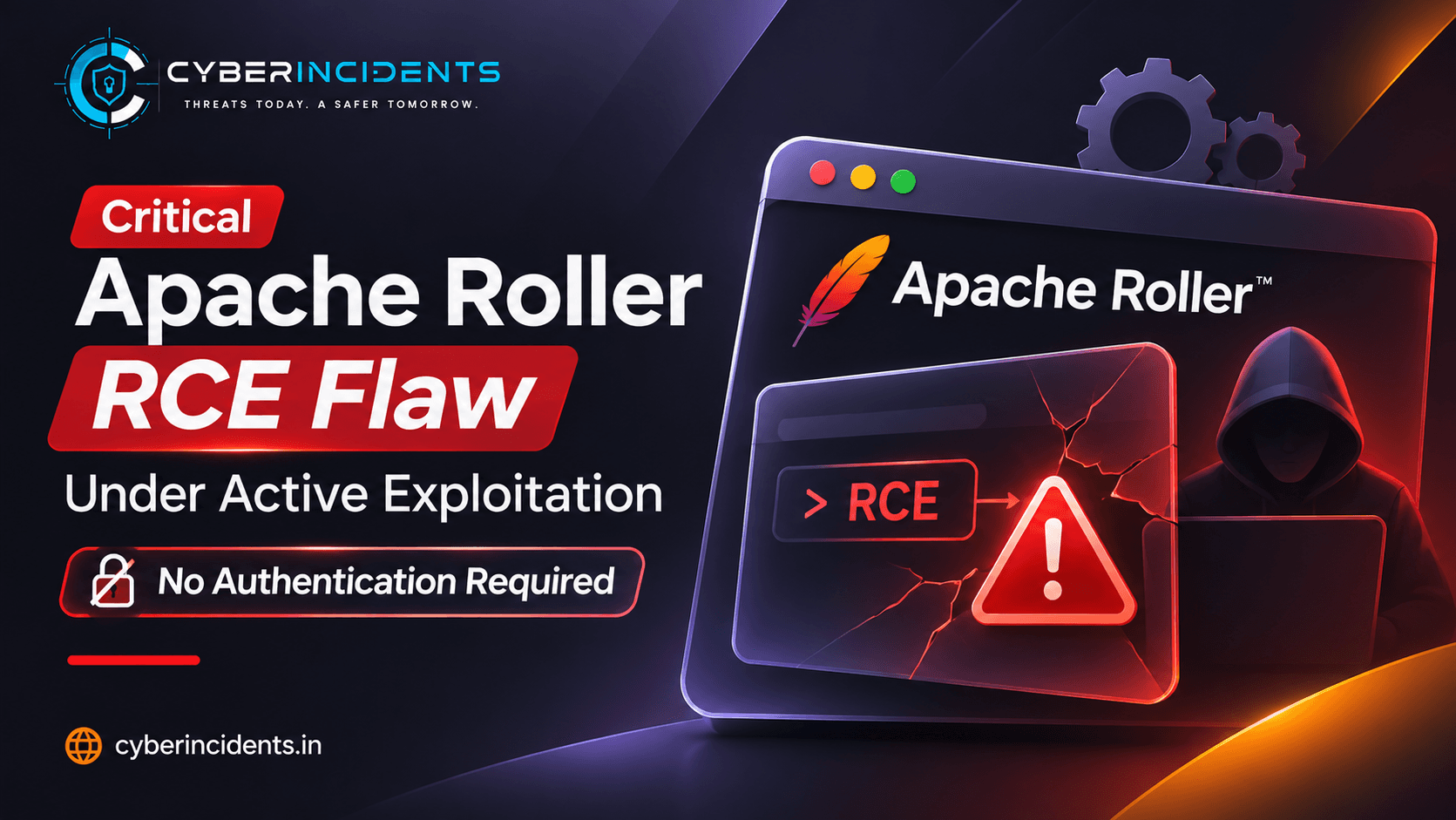
A critical remote code execution (RCE) vulnerability in Apache Roller, an open-source Java-based blogging platform, is reportedly being actively exploited in the wild.
Tracked as CVE-2026-129448, with a CVSS score of 9.8, the vulnerability allows unauthenticated remote attackers to execute arbitrary code through an insecure deserialization flaw in the platform's XML-RPC endpoint.
The issue occurs because Apache Roller accepts vendor extension types and deserializes incoming XML-RPC requests before authenticating the requester. Consequently, an attacker does not need valid credentials to exploit a vulnerable instance.
The Apache Software Foundation (ASF) recommends upgrading to Apache Roller 6.1.6 or later. Organizations unable to patch immediately should disable the vulnerable XML-RPC extension functionality or remove the XML-RPC servlet mapping.
Key highlights:
CVE: CVE-2026-129448
Severity: Critical
CVSS: 9.8
Vulnerability type: Unauthenticated insecure deserialization
Potential impact: Remote code execution
Affected versions: Apache Roller 4.0.0 through 6.1.4
Exploitation status: Active exploitation reported by ASF
Fixed version: Apache Roller 6.1.6 or later
Apache Roller is an open-source, Java-based blogging platform maintained under the Apache Software Foundation.
It provides functionality for managing blogs, publishing content, and handling web-based blogging services. Its XML-RPC interface supports remote interactions with the platform.
The recently disclosed vulnerability affects the XML-RPC endpoint, which processes incoming requests and supports vendor extension types.
The vulnerability is an unauthenticated deserialization flaw that can allow an attacker to execute arbitrary code remotely.
According to the Apache Software Foundation, affected Apache Roller versions deserialize untrusted data received through the XML-RPC endpoint before authenticating the requester.
This creates an opportunity for an unauthenticated attacker to submit specially crafted XML-RPC requests that trigger unsafe deserialization.
The vulnerability involves the following sequence:
An attacker identifies an internet-accessible Apache Roller instance running a vulnerable version.
The attacker sends a crafted request to the XML-RPC endpoint.
Apache Roller accepts vendor extension types in the incoming request.
The application deserializes the supplied data before validating the requester's authentication.
The insecure deserialization process can be abused to execute arbitrary code on the vulnerable server.
Because deserialization happens before authentication, an attacker does not need a valid account to reach the vulnerable processing functionality.
Successful exploitation could provide an attacker with the ability to execute commands within the security context of the application process.
The supplied advisory does not disclose the exact exploit payload, attack infrastructure, or post-exploitation techniques.
The combination of unauthenticated access and remote code execution makes this vulnerability particularly serious.
Potential consequences include:
Unauthorized execution of commands on the affected server.
Compromise of the Apache Roller application.
Access to sensitive application data.
Potential exposure of database credentials and configuration secrets accessible to the application.
Installation of malicious tools or persistence mechanisms.
Further movement into connected infrastructure, depending on the server's privileges and network access.
These are potential consequences of successful exploitation, not confirmed outcomes for every affected instance.
The Apache Software Foundation stated that CVE-2026-129448 is the same underlying issue as CVE-2026-82384, which was patched in September 2026.
The earlier vulnerability was reported as affecting Apache Roller 6.1.5.
The latest advisory expands the affected-version information to include Apache Roller versions 4.0.0 through 6.1.4.
This makes it important for administrators to review older installations rather than assuming that only the previously identified version is affected.
The Apache Software Foundation has confirmed that the vulnerability is being actively exploited in the wild.
However, the advisory does not provide details about:
The identity of the attackers.
The number of compromised servers.
Targeted organizations or industries.
Exploit payloads.
Attacker infrastructure.
Specific post-exploitation activity.
Organizations running internet-facing Apache Roller instances should therefore prioritize identifying exposed systems and applying the security update.
The Apache Software Foundation recommends upgrading to:
<badge color="success">Fixed version</badge> Apache Roller 6.1.6 or later
The updated version disables the vulnerable extension types and rejects XML-RPC requests when the XML-RPC feature is disabled.
If immediate patching is not possible, administrators can apply the following temporary mitigations.
Option 1: Disable vendor extension types
Set the following property to false in:
WEB-INF/web.xmlenabledForExtensions=falseOption 2: Remove the XML-RPC servlet mapping
Remove the following endpoint mapping from the application configuration:
/roller-services/xmlrpcRestart Apache Roller after applying the configuration change.
Important: Disabling XML-RPC through the administration interface alone is insufficient. According to ASF, older versions deserialize incoming requests before checking whether the XML-RPC feature is disabled.
Therefore, administrators should apply the recommended configuration-level mitigation or upgrade to the fixed version.
The supplied advisory does not disclose confirmed malicious IP addresses, domains, file hashes, or exploit payloads.
The following are vulnerability-related investigation pivots, not confirmed malicious IOCs.
| Indicator | Details |
|---|---|
| Product | Apache Roller |
| Vulnerability | CVE-2026-129448 |
| Related vulnerability | CVE-2026-82384 |
| CVSS | 9.8 |
| Vulnerable component | XML-RPC endpoint |
| Endpoint path | /roller-services/xmlrpc |
| Vulnerability type | Unauthenticated insecure deserialization |
| Potential impact | Remote code execution |
| Affected versions | 4.0.0 through 6.1.4 |
| Fixed version | 6.1.6 or later |
SOC teams should prioritize identifying internet-facing Apache Roller deployments and investigating suspicious requests to the XML-RPC endpoint.
Review asset inventories, vulnerability scanners, and web application discovery data to identify:
Apache Roller installations.
Externally accessible application servers.
Vulnerable software versions.
Systems exposing /roller-services/xmlrpc.
Applications that have not received the latest security updates.
Prioritize internet-facing systems running affected versions.
Review web server access logs for requests targeting:
/roller-services/xmlrpcInvestigate:
Unexpected POST requests.
Repeated requests from unfamiliar source IP addresses.
Unusual request sizes.
Unexpected content types.
Abnormal request patterns.
Requests followed by suspicious server-side activity.
A request to the XML-RPC endpoint alone is not proof of exploitation. Legitimate applications may use the endpoint, so investigate the request context and subsequent activity.
Look for suspicious activity around the time of XML-RPC requests:
Unexpected Java process behaviour.
Unusual child processes spawned by the application server.
Shell execution initiated by Java processes.
Unexpected outbound network connections.
Creation of unfamiliar files.
Changes to application directories.
Unusual authentication activity on the underlying host.
If exploitation is suspected, review endpoint and server telemetry for:
Commands executed by the application service account.
Unexpected scripts or binaries.
New user accounts.
Changes to scheduled tasks or services.
Suspicious outbound connections.
Access to application configuration files and credentials.
Attempts to access other internal systems.
Correlate these events with the web server's XML-RPC access logs.
1. Identify requests to the vulnerable XML-RPC endpoint
index=web
"/roller-services/xmlrpc"
| stats count as request_count
        values(http_method) as methods
        values(status) as response_codes
        by src_ip uri_path
| sort -request_count
2. Identify repeated requests to the endpoint
index=web
uri_path="/roller-services/xmlrpc"
| bin _time span=5m
| stats count as request_count
        values(status) as response_codes
        by _time src_ip
| where request_count > 10
| sort -request_count
3. Identify Java processes spawning command interpreters
index=edr
| search parent_process_name="java"
    (process_name="sh"
    OR process_name="bash"
    OR process_name="dash"
    OR process_name="cmd.exe"
    OR process_name="powershell.exe")
| table _time host user parent_process_name
        process_name process_command_line
| sort -_time
These are starting-point searches. Field names, indexes, and event formats must be adapted to the organization's web server and EDR telemetry.
Upgrade immediately: Move affected Apache Roller installations to version 6.1.6 or later.
Disable XML-RPC extensions: If patching is delayed, set enabledForExtensions to false in WEB-INF/web.xml.
Remove vulnerable endpoint mapping: Remove /roller-services/xmlrpc where the functionality is not required.
Restart the application: Ensure configuration changes take effect.
Review web server logs: Investigate suspicious requests to the XML-RPC endpoint.
Restrict external exposure: Limit access to the application through approved networks and security controls.
Investigate suspicious processes: Review Java child processes and unexpected command execution.
Check application credentials: Assess whether database credentials and other secrets accessible to the application may have been exposed.
Perform compromise assessment: If suspicious activity is identified, investigate persistence, lateral movement, and potential data access.
Prioritize exposed systems: Treat internet-facing vulnerable deployments as high-priority remediation targets.
SOC Recommendation: Since active exploitation has been confirmed by ASF and the vulnerability allows unauthenticated remote code execution, prioritize identifying vulnerable Apache Roller instances, reviewing XML-RPC endpoint activity, and checking for suspicious Java process execution. Do not assume that patching alone resolves an existing compromise.
Continue reading
Cyber News
Vishing
Cyber News
Identity Theft and Data Extortion

Cyber News
Credentials Compromise
3 entries, most recent posts.
Vishing
Identity Theft and Data Extortion
AI-Assisted Autonomous Intrusions