Cyber News
Chinese State-Sponsored Hackers Use AI-Powered ARTEX Framework to Target 200+ Organizations Worldwide
Cyber Espionage / Artificial Intelligence
10 min read


Vulnerability / Network Security
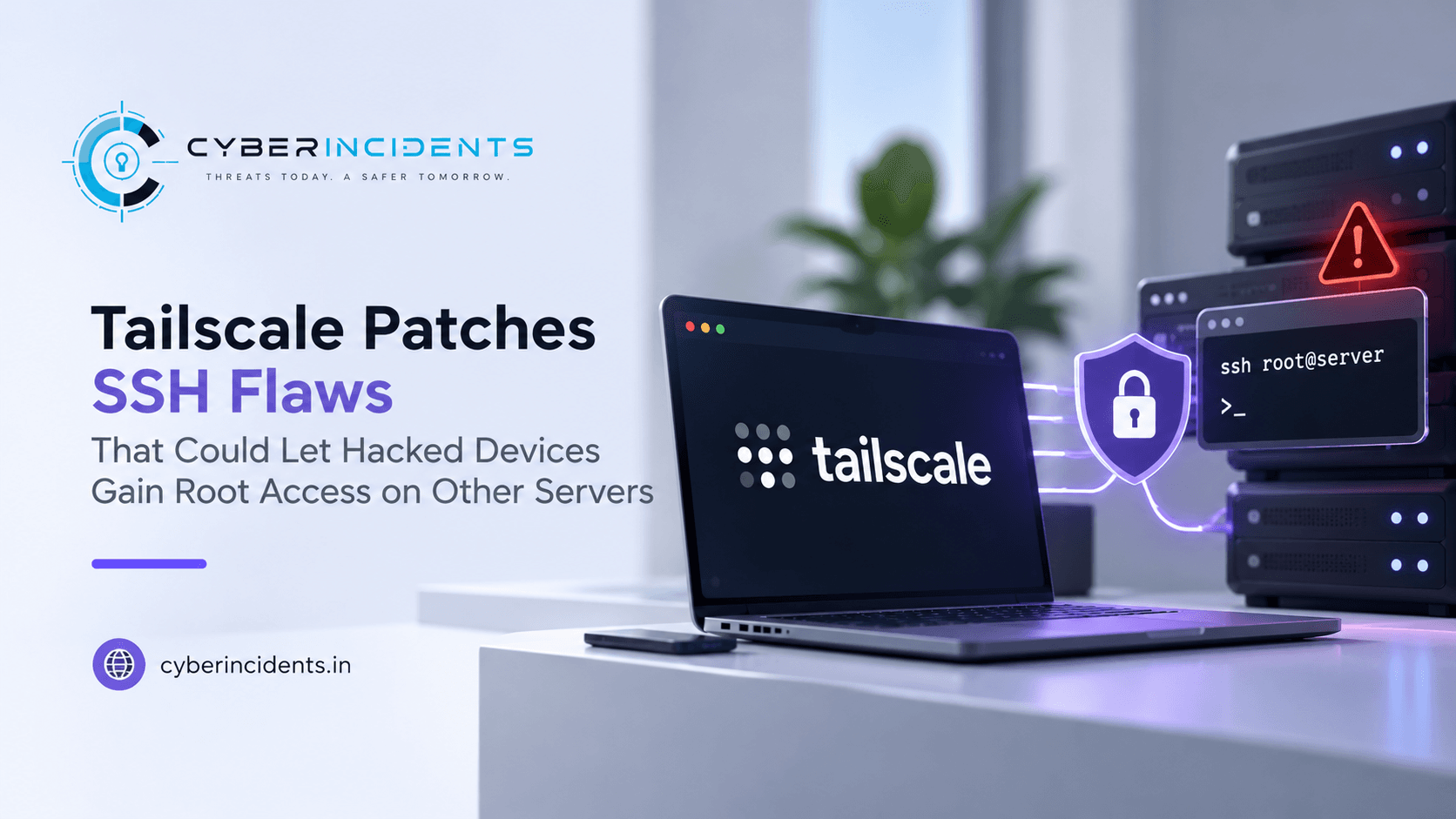
Tailscale released version 1.104.4 to address multiple security vulnerabilities affecting its built-in SSH server and related services. The flaws could allow an attacker who already has authorized access through Tailscale SSH to reach privileged Unix sockets, potentially gain root-level control, or disrupt networking on an affected node.
The vulnerabilities were identified by Erica Windisch of Cyberdione Labs during security testing of Tailscale 1.104.2 and the self-hosted Headscale control server v0.29.5.
Affected components: Tailscale SSH, tailscale serve, and related services.
Fixed version: Tailscale 1.104.4 or later.
Primary risk: Privilege escalation through Unix-socket forwarding.
Other impacts: Service crashes, access to the local Tailscale API, and authorization issues involving service mounts.
Exploitation status: The supplied reports do not confirm exploitation in real-world attacks.
Immediate action: Upgrade affected Tailscale clients and servers, review SSH access policies, and disable SSH forwarding where patching is not yet possible.
Tailscale is a mesh VPN built on WireGuard that connects devices, servers, and cloud workloads through an encrypted private network known as a tailnet. Its Tailscale SSH feature enables access to authorized systems based on device identity and network access policies.
Security researchers identified a group of 11 vulnerabilities collectively known as Tailworm. The findings covered Tailscale 1.104.2 and Headscale v0.29.5, although the issues affect different components and have different exploitation requirements.
The most serious findings involved Tailscale SSH, where an authorized connection could potentially be used to perform operations beyond the permissions intended for the connecting user.
Tailscale subsequently released version 1.104.4, addressing four security bulletins associated with SSH forwarding, service exposure, and related authorization issues.
The main vulnerability class concerns how Tailscale SSH handles connections forwarded to Unix-domain sockets.
Unix sockets allow local processes to communicate with services, including privileged administrative interfaces. Access to sockets such as the Docker control socket or the local Tailscale API can provide powerful capabilities.
According to the researchers, Tailscale's background service performed certain forwarding operations with root privileges. Its path-validation logic could be bypassed through a timing race in which an attacker changed the targeted path after the initial check.
The reported attack sequence was:
Obtain an authorized foothold: The attacker controls a device permitted by the tailnet's access policy to establish an SSH session with the target.
Establish a Tailscale SSH session: The attacker connects through the approved access path.
Request Unix-socket forwarding: The attacker uses SSH forwarding to reach a local Unix socket on the target system.
Exploit the validation race: The attacker attempts to replace or redirect the socket path after validation.
Reach privileged functionality: The vulnerable service performs operations with excessive privileges, potentially exposing root-only services or resources.
Escalate privileges: Depending on the target configuration and available socket, the attacker may obtain elevated control over the target server.
In their laboratory testing, the researchers reported obtaining a root shell through forwarding to the Docker control socket and reading /etc/shadow.
This demonstrates the potential severity of the issue, but it does not mean that every vulnerable installation is automatically exploitable. Access policies, system configuration, operating-system permissions, and the available forwarding capabilities influence the outcome.
Tailscale's release addressed four security bulletins:
| Bulletin | Reported issue | Potential impact |
|---|---|---|
TS-2026-014 | SSH Unix-socket forwarding flaws | Access to privileged sockets, potentially enabling privilege escalation |
TS-2026-015 | Resource exhaustion through an authorized SSH session | Tailscale process crash and loss of Tailscale networking on the affected node |
TS-2026-016 | tailscale serve Unix-socket forwarding and socket-swap issues | Potential access to the local Tailscale API and remote control of the node |
TS-2026-017 | Permission-header mix-up involving TLS Serve with two or more mounts | A request may receive another mount's permission headers |
The initial Tailworm research also discussed Headscale control-server resource exhaustion and an experimental app-connector issue. The reporting states that the app-connector finding affected the experimental conn25 feature, not the connectors currently offered to customers.
The researchers described the vulnerability chain as potentially “wormable” because a compromised device could use existing authorized connections to move to other permitted devices.
The concern is that an attacker may not need to steal a separate password or SSH key for every target. A foothold on a device trusted by the tailnet could provide a route to additional systems, depending on the network's access rules.
Tailscale disputed the use of the term “wormable,” explaining that the findings did not demonstrate self-replicating malware spreading autonomously. Instead, the company characterized the risk as lateral movement constrained by the tailnet's existing authorization policies.
For defenders, the distinction does not remove the risk. Broad device-to-device permissions can increase the number of systems reachable after a single endpoint is compromised.
Tailscale released version 1.104.4 to address the four security bulletins. The SSH forwarding fix changes the server so that forwarding is performed as the logged-in user rather than root, relying on operating-system permissions instead of the previous path-validation approach.
Recommended actions include:
Upgrade Tailscale clients and servers to version 1.104.4 or later.
Review tailnet policies and remove unnecessary SSH access.
Disable SSH forwarding temporarily if a system cannot be updated immediately.
Restrict access to sensitive servers to the specific users and devices that require it.
Review Headscale deployments separately because the supplied reporting states that Headscale v0.29.5 did not fix the reported issues.
If a device may already be compromised, investigate device identity and key validity in addition to installing the patch.
The documented mitigation for SSH forwarding is to set TS_SSH_DISABLE_FORWARDING=1 in the tailscaled service environment and restart the service. Administrators should verify the correct service configuration for their operating system and deployment.
Tailscale also recommends reviewing SSH access policies and considering SSH check mode for sensitive systems. Check mode requires the user to authenticate again before a session starts, but it does not prevent the reported forwarding flaws inside an already authorized session.
The supplied reports do not provide confirmed malicious IP addresses, domains, file hashes, or other campaign-specific indicators of compromise. The vulnerability is primarily associated with application behaviour and authorization conditions.
Useful investigation pivots include:
| Pivot | Purpose |
|---|---|
Tailscale versions earlier than 1.104.4 | Identify installations requiring remediation for the reported bulletins |
Headscale v0.29.5 | Identify the self-hosted control-server version discussed in the research |
TS-2026-014 to TS-2026-017 | Reference the four security bulletins addressed by Tailscale 1.104.4 |
TS_SSH_DISABLE_FORWARDING=1 | Documented mitigation setting for disabling SSH forwarding |
| Unexpected access to Docker or Tailscale Unix sockets | Investigate possible abuse of privileged local interfaces |
| Unexpected Tailscale service crashes | Investigate potential resource-exhaustion activity |
These are investigation pivots, not proof of compromise. A vulnerable version or a service crash alone does not establish that an attacker exploited Tailworm.
Inventory Tailscale clients, Linux servers, supported macOS installations, and self-hosted Headscale deployments.
Identify Tailscale installations earlier than version 1.104.4.
Identify Headscale deployments and verify their remediation status against the relevant advisories.
Prioritize systems that accept Tailscale SSH connections and host sensitive services.
Track patch deployment and investigate devices that remain out of compliance.
Examine tailnet policy files to identify devices and users with SSH access to critical infrastructure.
Look for broad rules that permit many devices to connect to sensitive servers, particularly where forwarding is enabled.
Reduce access to specific user-device combinations and limit administrative connectivity to systems that genuinely require it.
Where host auditing and process telemetry are available, investigate unexpected attempts to access sensitive Unix sockets.
Prioritize Docker control sockets, the local Tailscale API, and other privileged service interfaces.
Correlate socket activity with SSH sessions, process execution, file operations, and privilege changes. The supplied reports do not specify universal log signatures for exploitation, so investigations should use the available host telemetry rather than depend on a single event identifier.
Review Linux audit logs, endpoint detection telemetry, and process execution records for unexpected privileged activity associated with Tailscale sessions.
Investigate:
Unexpected root-level shells or processes.
Unusual access to /etc/shadow or other protected files.
Unexpected interaction with the Docker control socket.
Administrative API access inconsistent with normal Tailscale operations.
Suspicious file deletion or changes to privileged resources.
Correlate these events with the account, device, and time of the Tailscale SSH session.
Review service logs and endpoint telemetry for repeated Tailscale process crashes, abnormal memory consumption, or unexplained loss of tailnet connectivity.
Determine whether the disruption coincided with SSH sessions or other activity from authorized but potentially compromised devices.
If a device is suspected of compromise, map the systems it could reach under the existing tailnet policy.
Review related authentication, endpoint, and service logs on those targets. If the compromised device's identity or key may have been exposed, follow the organization's containment process and revoke or remove the device identity as appropriate.
Patch promptly: Upgrade affected Tailscale deployments to version 1.104.4 or later.
Disable unnecessary forwarding: Use TS_SSH_DISABLE_FORWARDING=1 as a temporary mitigation when immediate patching is not possible.
Apply least privilege: Restrict SSH access to the users and devices that need it.
Reduce network reachability: Prefer narrow device-to-device access rules over broad connectivity permissions.
Protect sensitive servers: Review access to Docker sockets, administrative APIs, and other privileged local interfaces.
Review Headscale separately: Confirm the status of self-hosted deployments using the applicable project advisories.
Investigate suspected compromise: Do not rely on patching alone if a device may already have been compromised; review device identity, key validity, privileged activity, and lateral movement.
Monitor service health: Alert on unexpected Tailscale crashes, memory exhaustion, and unexplained network interruptions.
Validate remediation: Confirm that updates and policy changes are effective on the actual hosts.
Continue reading
Cyber News
Cyber Espionage / Artificial Intelligence
Cyber News
Vulnerability / Endpoint Security
Cyber News
Identity Security / Artificial Intelligence

3 entries, most recent posts.
Cyber Espionage / Artificial Intelligence
Vulnerability / Endpoint Security
Homograph attacks